Developing the DHE Scale
Initial findings from the pilot
Progress to date
- Scoping review of mechanisms
- Literature review of existing scales
- Semi-structured interviews (N=9)
- Model development
- Delphi study with subject-matter experts
- Pretesing/Cognitive interviews (N=10)
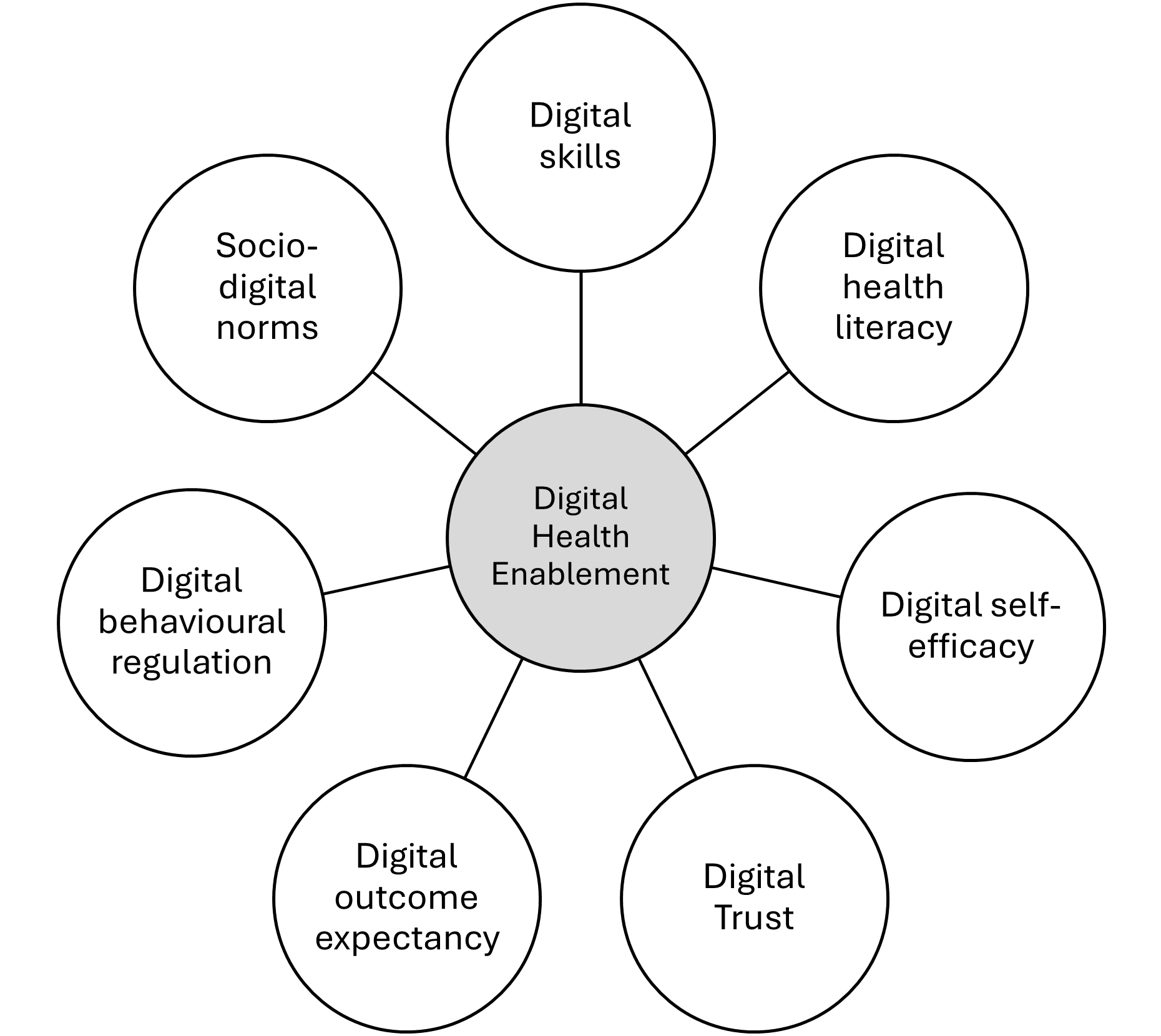
Digital Health Enablement (DHE)
![]()
Survey pilot
- 65 participants (50 Prolific, 15 paper)
- Demographic quotas on Prolific
- 45 items across 7 sub-constructs
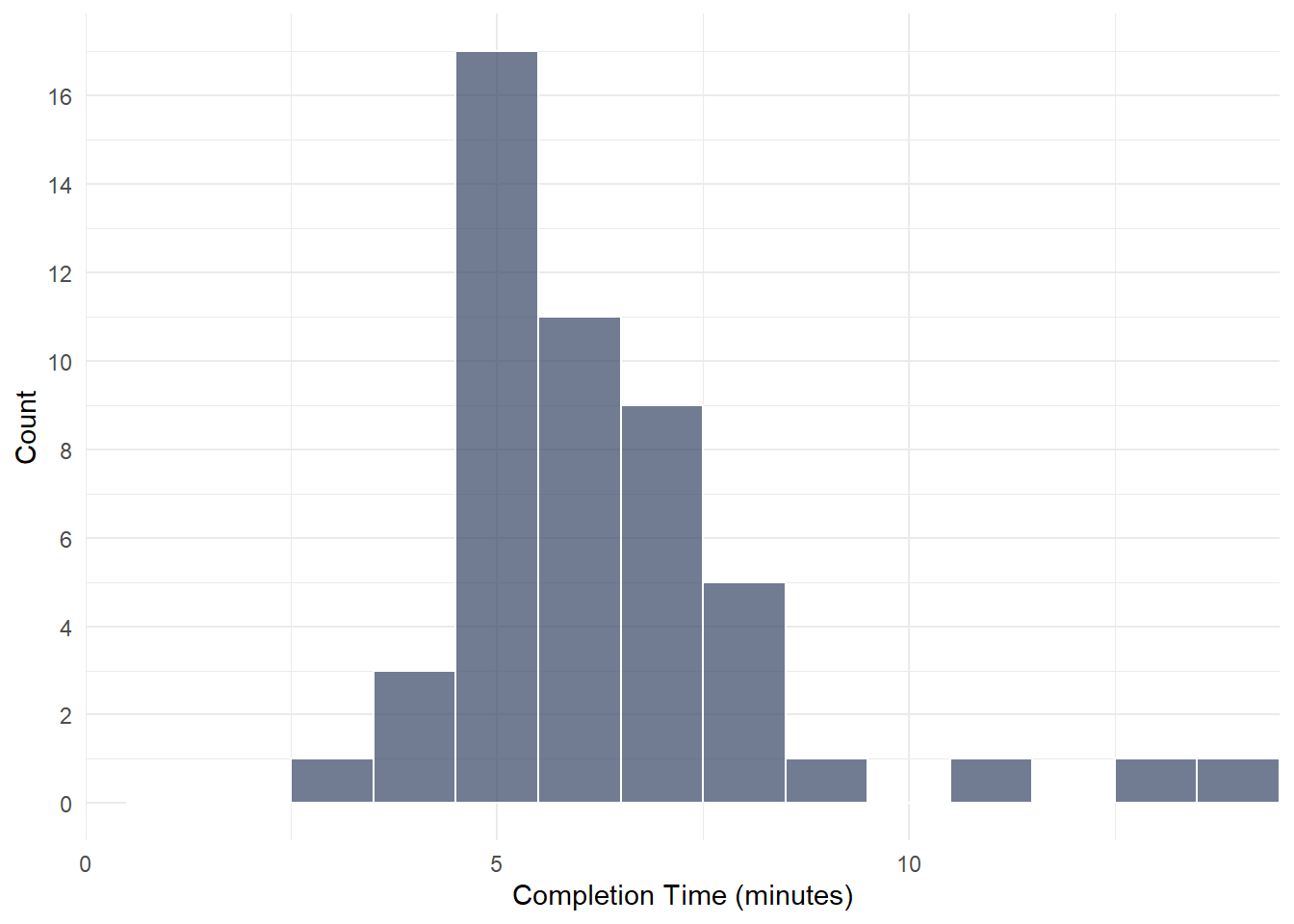
Prolific completion times
![]()
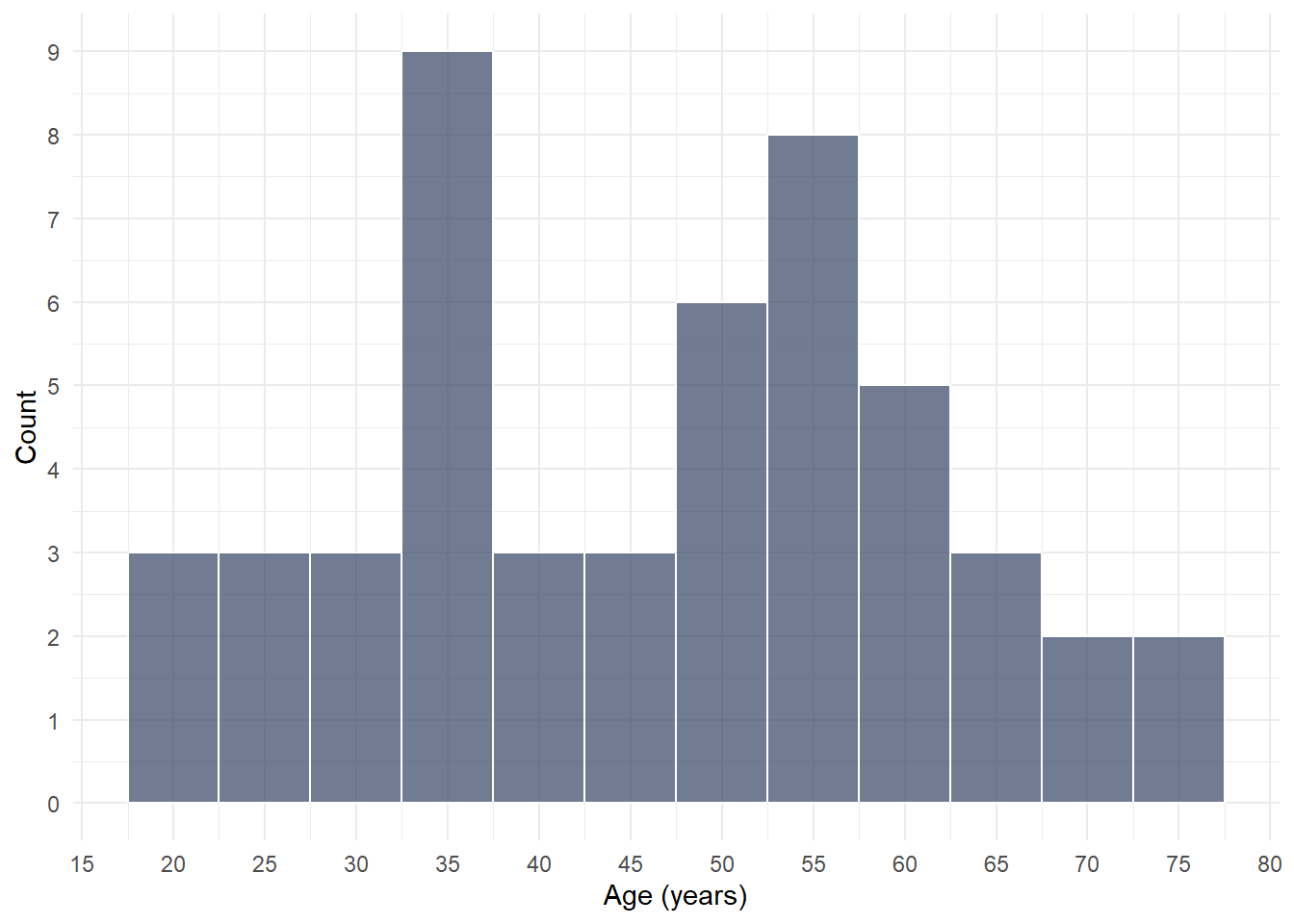
Demographics: Age
![]()
Demographics: Education
| No Qualifications |
6 |
12 |
| School-level |
14 |
28 |
| Vocational and technical |
7 |
14 |
| Further education |
6 |
12 |
| Higher education |
1 |
2 |
| Undergraduate Degree |
10 |
20 |
| Postgraduate and professional |
6 |
12 |
Demographics: Income
| Less than £19,000 a year |
16 |
32 |
| £19,001 to £28,000 |
13 |
26 |
| £28,001 to £38,000 |
10 |
20 |
| £38,000 to £55,000 |
4 |
8 |
| More than £55,000 a year |
7 |
14 |
Demographics: Gender & Ethnicity
| English/Welsh/Scottish/Northern Irish/British |
44 |
88 |
| Indian |
2 |
4 |
| Any other White Background |
1 |
2 |
| Chinese |
1 |
2 |
| White and Black African |
1 |
2 |
| White and Black Caribbean |
1 |
2 |
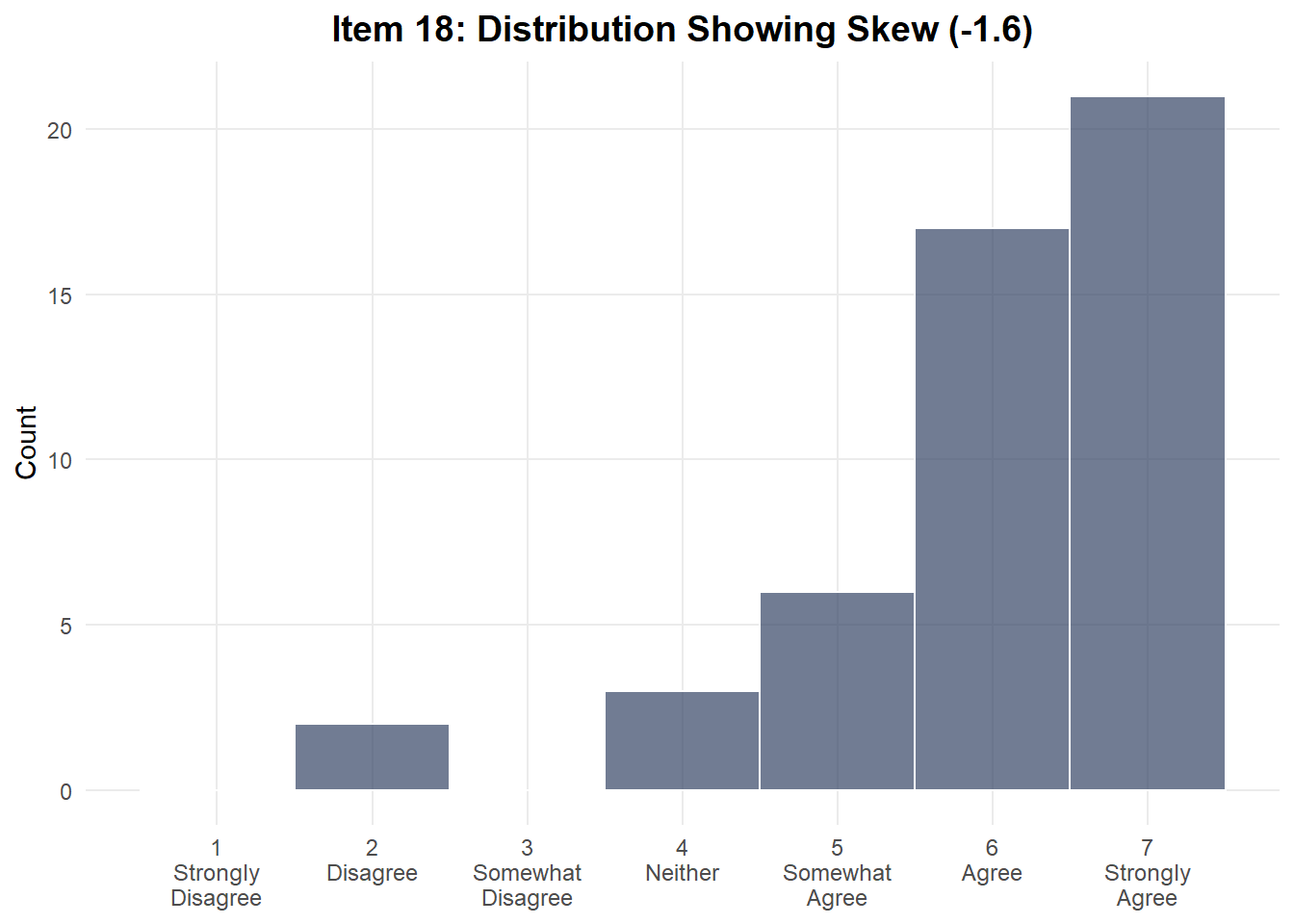
Issues: Skew (1)
Item 18 - “I would expect health technologies to have measures in place to keep my information safe”
![]()
Issues: Skew (2)
- 11 (of 45) items demonstrated problematic skew, ceiling/floor effects or low variance
- This limits the ability to discriminate between individuals
- Consider item removal or revisions
- E.g. “I often struggle to use digital technology” could be revised to “I sometimes struggle to use digital technology”
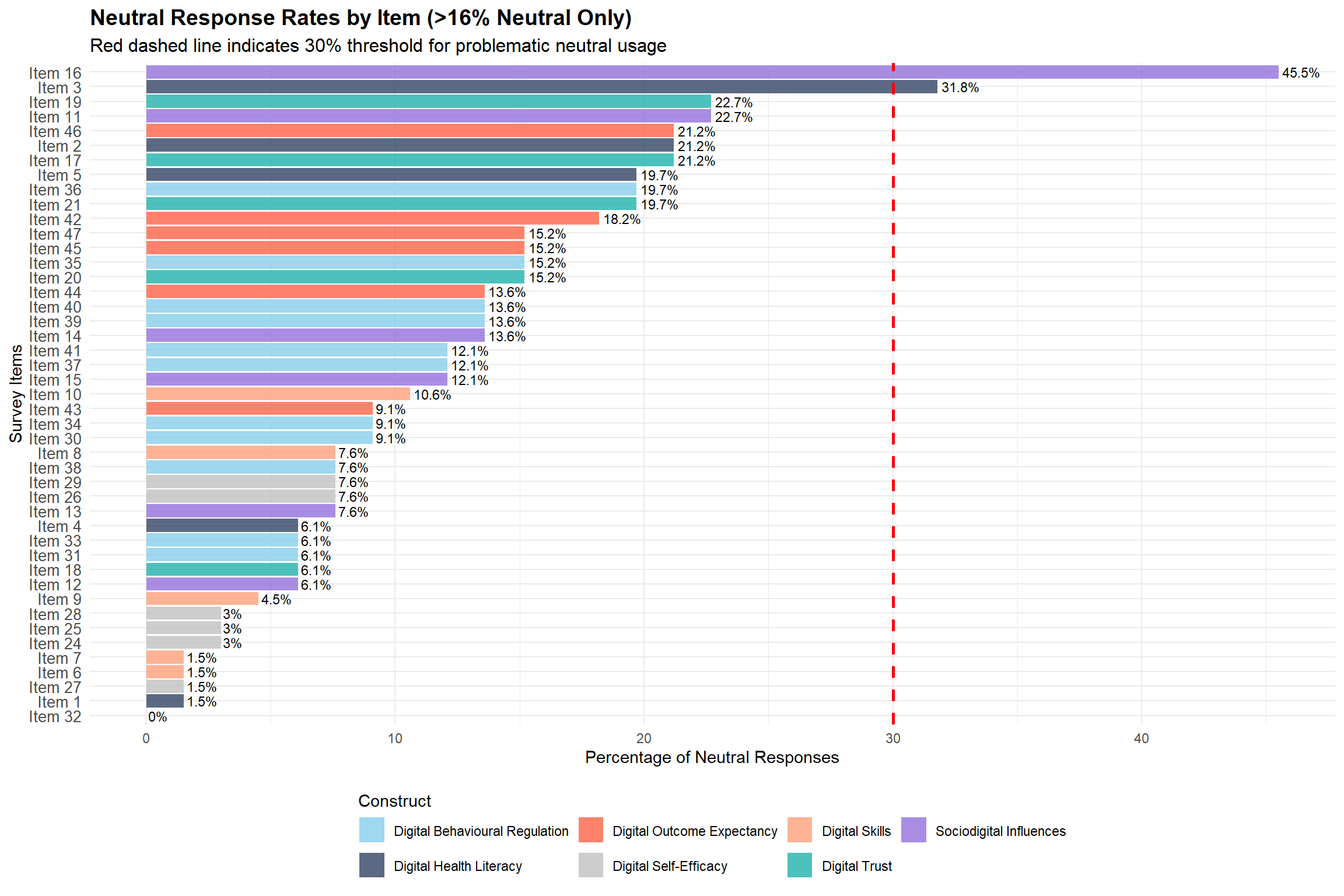
Issues: Neutral responses (1)
![]()
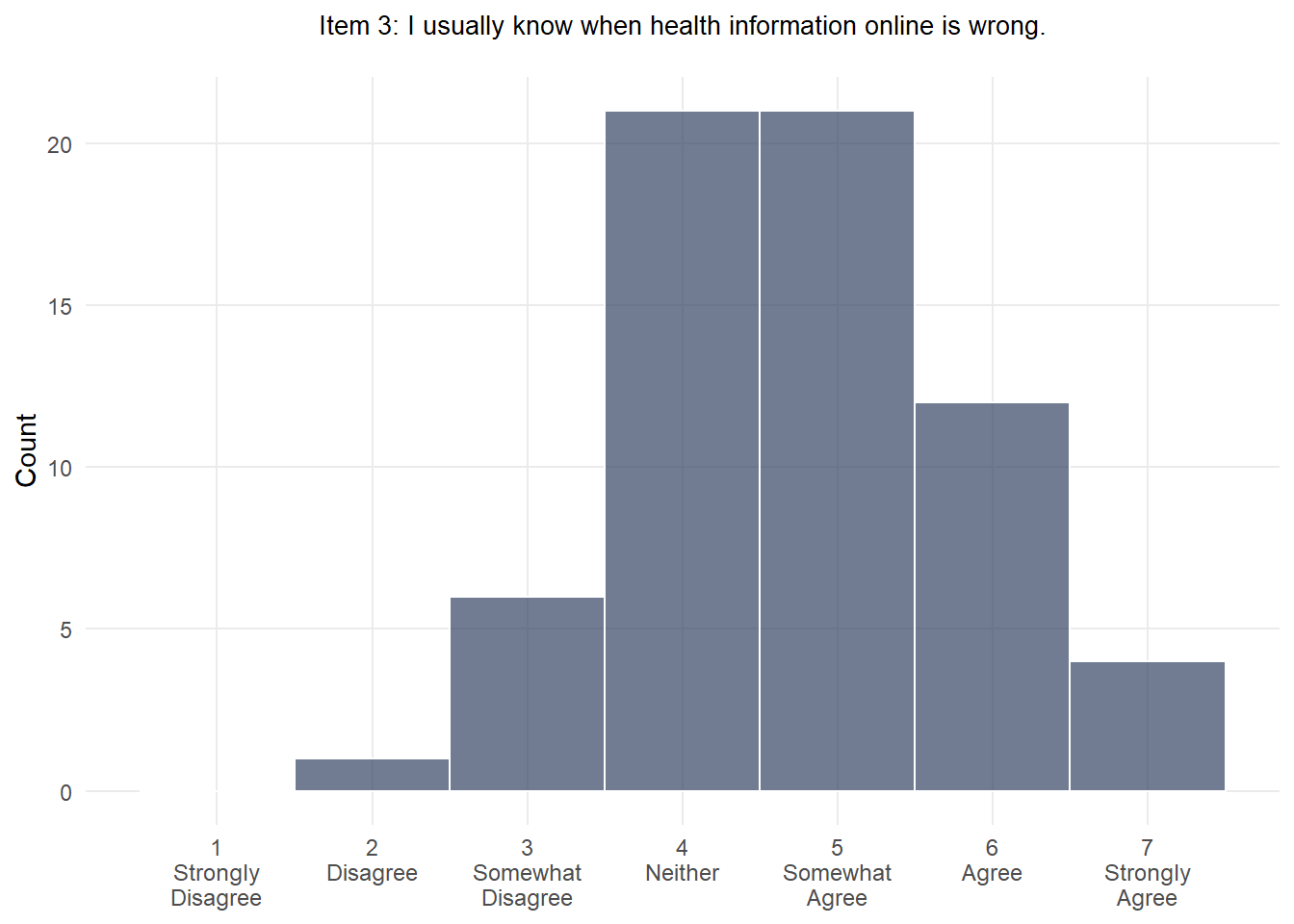
Issues: Neutral responses (2)
![]()
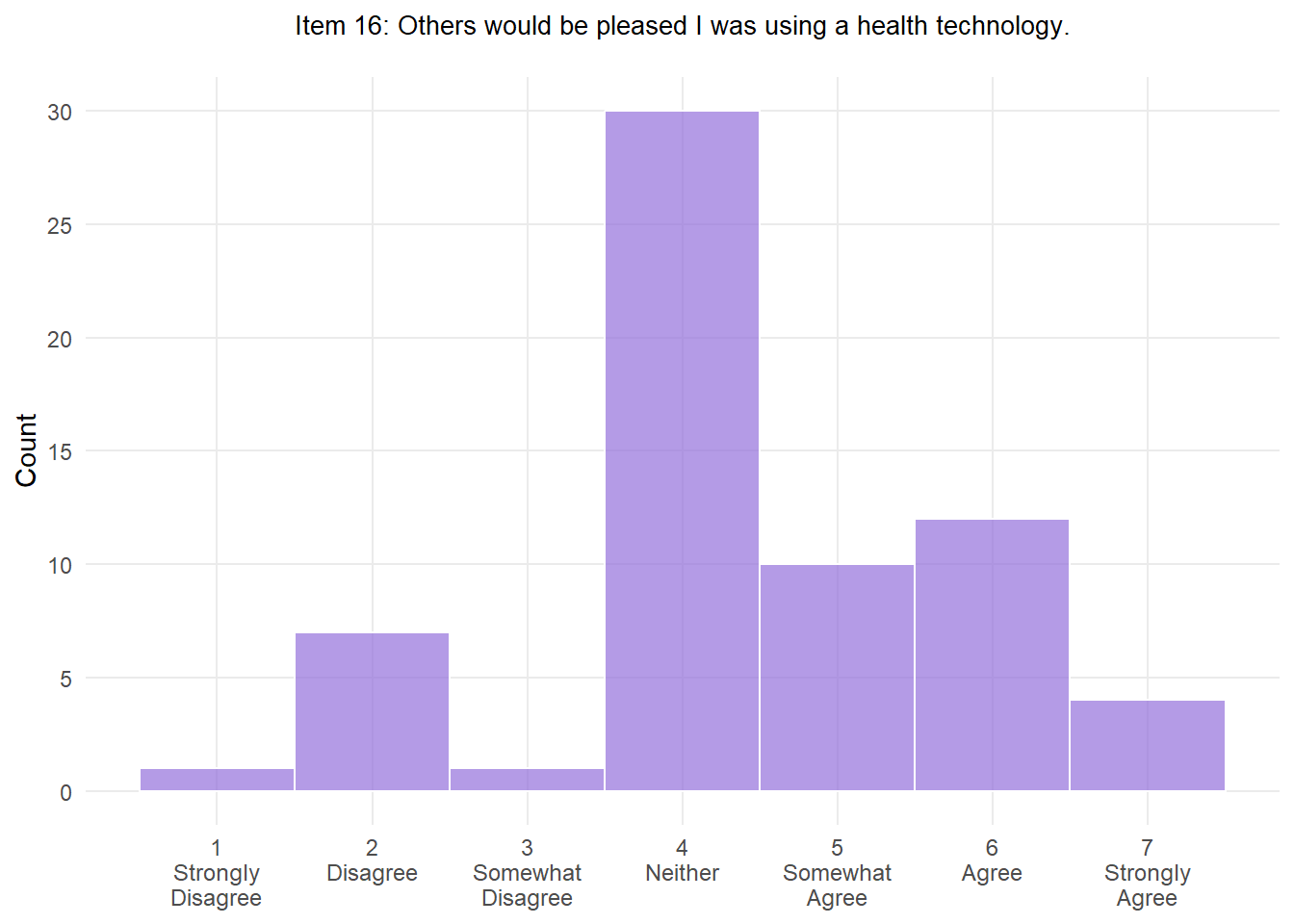
Issues: Neutral responses (3)
![]()
Issues: Neutral responses (4)
| Participants who used neutral ≥50% of the time |
0 out of 66 (0%) |
| Participants who used neutral ≥30% of the time |
2 out of 66 (3%) |
| Mean participant neutral usage |
12% |
| Median participant neutral usage |
8.9% |
Issues: Method effects
- Use of fitness app (rather than generic ‘health technology’) may create a method effect.
- Method effects occur when similar wording across items inflates correlations.
- Especially the case where one sub-construct relies on ‘fitness app’ exclusively
- Solution: replace fitness app with ‘health technology’ throughout
Issues: Poor factor loadings
Factor loadings
- Little consensus on factor loadings, but >0.7 generally considered good.
- However, may retain items with moderate loading + good content validity. E.g. “I can usually adjust the settings on digital technology to suit my needs” (loading: 0.578)
- Remove items with poor factor loading + poor content validity (e.g. digital health trust)
- Solution: consider revising factors/ model.
Options
- Retain 7 factor model, revise problematic items.
- Adopt a 2 factor model based on pliot data
- Test 3 factor model at pilot, extend Factor 3: context and support.
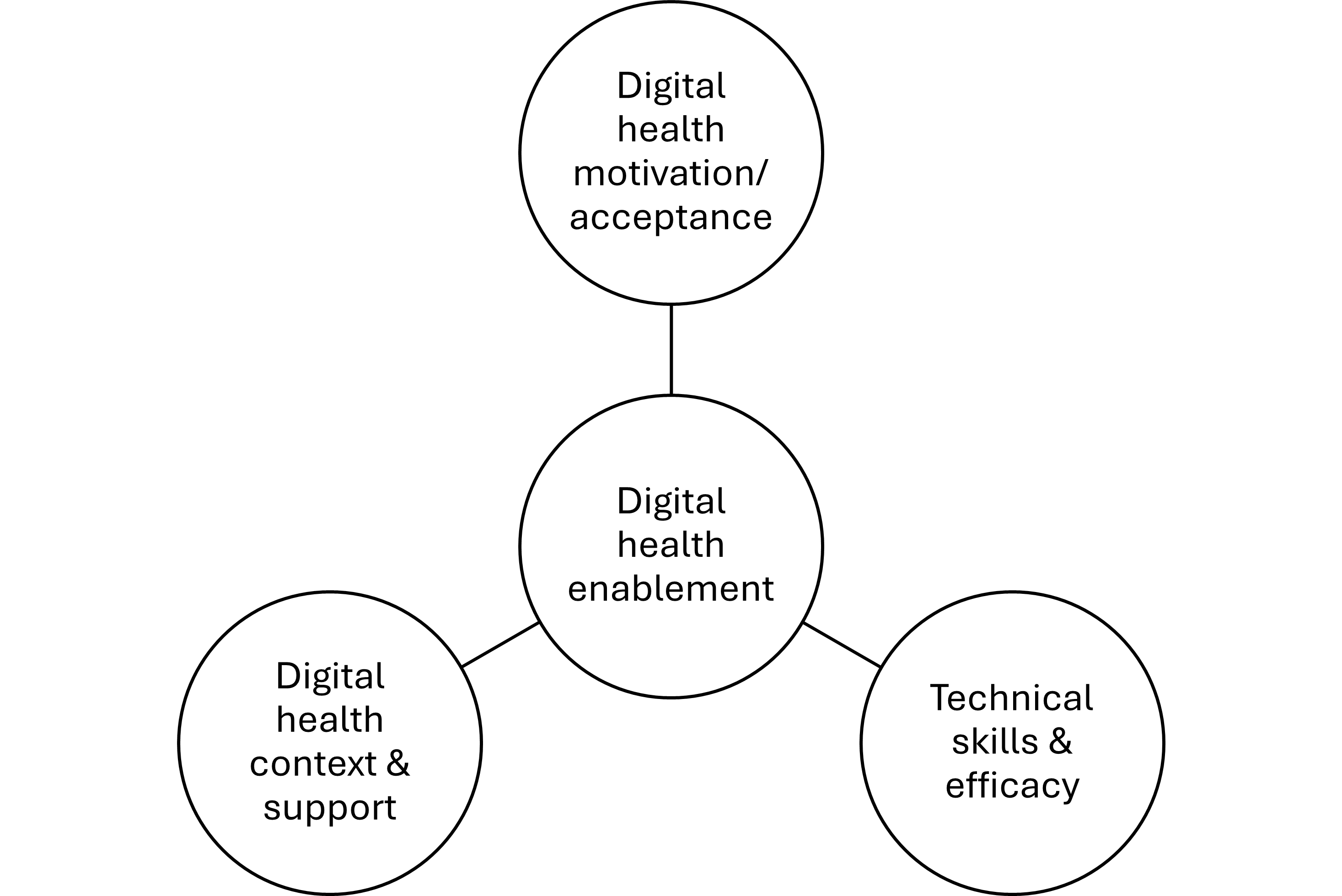
3-Factor model (1)
![]()
3-Factor model (2)
1. Digital Health Motivation & Acceptance
- Question: “Do I want to use digital health technologies?”
- Attitudes, trust, outcome expectancy, intention
2. Technical Skills & Self-Efficacy
- Question: “Can I technically perform the required tasks?”
- Skills, troubleshooting confidence, technical competence
3. Digital Health Context & Support
- Question: “Is my environment conducive to success?”
- Social support, environmental barriers, external pressures
3-Factor Model (3)
Additional social context & support items
- “Those close to me would support my use of a health app”
- “Using health apps is normal in my social groups”
- “Others like me already use health apps”
- “Those close to me would encourage me to use a health app”
- “Most people I know use health apps”
- “Those close to me would help me getting going with a health app”
- “Those close to me would encourage me to keep going with a health app”
3-Factor Model (4)
Other proposed changes
- Change all items to health technology from fitness apps (OR VICE VERSA)
- Revise or remove items with problematic skew.
- Remove items with weak loadings.
- Remove items related to Trust.
- Remove theoretically inconsistent items from revised factors.
- Remove Item 16 (45% neutral response).
3-Factor Model (5)
| Factor 1 Motivation & Acceptance |
23 |
⚠️ Too many |
Redundancy, weak items |
8-10 |
| Factor 3 Technical Skills |
13 |
✅ Good foundation |
Minor tweaks needed |
6-8 |
| Factor 2 Context & Support |
8 |
⚠️ Needs strengthening |
Few strong items, poor wording |
8-10 |
| Total |
44 |
|
|
22-28 |
Factor 1: Motivation & Acceptance
- I would use [a fitness app] because I am motivated to improve my health.
- I would enjoy using [a fitness app] to improve my health.
- I believe that using [a fitness app] would be good for me.
- I can’t see why I should bother using [a fitness app].
- Because I am not interested in using technology to support my health, I wouldn’t use [a fitness app].
- I believe that using [a fitness app] would improve my physical health.
- I don’t think [a fitness app] would work for me.
- I would get a sense of accomplishment if I used [a fitness app].
- I would use [a fitness app] because I want to learn about my health.
- I believe that using [a fitness app] would lead to me living a healthier lifestyle.
- I would use [a fitness app], because I find exploring new health technologies exciting.
Factor 2: Technical Skills & Self-Efficacy
- I can troubleshoot basic issues with digital technology.
- I can usually use digital technology.
- I am confident I could use the advanced features of [a fitness app] if I wanted to.
- I would understand what [a health technology] was asking me to do to improve my health.
- I often struggle to use digital technology.
- I am confident I could troubleshoot basic issues with [a fitness app] if I wanted to.
- I am confident I could use [a fitness app] without help if I wanted to.
- I am confident I could learn how to use [a fitness app] if I wanted to.
- I can usually adjust the settings on digital technology to suit my needs.
Factor 3: Digital Health Context & Support
- I would use [a fitness app] because I would feel guilty if I didn’t.
- I would use [a fitness app] because I don’t want to let others down.
- I don’t have anyone in my life that could help me use [a health technology].
- Few people I know use [health technologies].
- Those close to me would support my use of [a health app].
- Using [health apps] is normal in my social groups.
- Others like me already use [health apps].
- Those close to me would encourage me to use a [health app].
- Most people I know use [health apps].
- Those close to me would help me getting going with a [health app].
- Those close to me would encourage me to keep going with a [health app].
Next steps
- Agree revisions/new model
- Conduct new pilot with revised items/models
- Test existing validated digital technology scales alongside DHE, e.g. Digital Health Literacy Instrument (DHLI)